The farce that is Security Theatre

EVERY DAMN TIME. I get frisked every damn time I enter a mall, a theatre, a hotel here in NCR (delhi-gurgaon-noida region). This here, as the debate rages over in the US, where many are very vocally deriding the silly invasive body scans and accusing of it just being security theater. If those earnest checks over there by US Homeland Security with the available funds and resources in that country is derided as lame and unnecessary, what hope do we have here with our barely literate security guards ?

My gym is inside a mall and the guards at the mall entrance don’t even bother opening the bag I walk in with. They frisk my body though. Because I am the dumb terrorist who will strap it to the groin ?? I think in 5 months all they have checked is if my gyming is making my buttocks firmer. A precursory press of the gluteus maximus is what I get every damn day. I suspect they even have a schedule. It’s the left cheek on even days and right on odd. So many many times I, on an impulse, wanted to see a movie but the ‘no bags policy’ drove me away to my dependable bit torrent. My money stayed in my wallet when it could have been in the theatre owners.

You don’t drive too far in your vehicle in the city you live in not because the roads don’t exist or the car is uncomfortable but because the hassle is directly proportional to the level of that activity. Testicular cupping without purpose is fun for no one. I hope. Ultimately, we are not peddling security. We are peddling the illusion of it . And it still costs a lot to mount and run, it is pretty ineffective and it annoys and drives away core constituency members. The money could be better spent on less intrusive technology that is just as effective. Read up on how Israel managers airport security.

So know how to pivot.  Spread the idea that shopping, movie watching and other mundane activities are safe and easy options. The odds are it is.

Why ‘Cost Plus Pricing’ is passé

Most of us here learn pricing strategy in business economics 101 from a cost plus angle. I want to sell this killer mouse trap Mr.Venture Capitalist/Loan Officer : It costs X dollars/rupees/pounds to make. I will add a y% margin and sell it. Voila!

That strategy died sometime in 2002.

aps1015-class-1-introduction-to-social-entrerpreneurship-27-638

Unless you are a pioneer in your niche, you are forever the slave to the guy who is the best in the business. And eventually it’s a race to the bottom. Unless you are Amazon. If I made a mousetrap in Boston/Birmingham/Bombay, in 1930 my pricing was competing and dependent on the pricing of that other mousetrap maker across town. Since I invented the damn thing and priced it at 100 shekel, the other guys have to use this as a base price when deciding to price their mouse traps.

In 1980, after industry deregulation, my pricing was competing and dependent on the pricing of mouse trap makers all across my country. Today, after deregulation and cheap container shipping costs became de riguer, my pricing is competing and dependent on the pricing of that bloody efficient mouse trap maker in Guangzhou (or that coding guy in Bangalore). And my sourcing costs does not stand a chance versus his.

Innovation and being a pioneer in serving a niche is the way forward as the world integrates even more tightly and your better dump this cost+ mentality quick and embrace a true innovater mentality.

The dilemma of hypersuccess

Since some of us were naive students asked to mug the begineer concepts epoused by Kotler, we students were de facto led to believe that the success of a product or service we sold is a good thing. More success is a great thing and hyper success the holy grail.

Now place yourself at customer# 53912482 of ….. Bombay Metro at 8 am, Uber, The City of Bangalore/Dhaka, The Woodstock concert,  tourist traps like Venice/Taj/Eiffel tower/Lady Liberty/Times Square, AT&T’s data service in Manhattan or the evening commute on TfL.

These are all ‘products’ that became, in various degrees, hypersuccessful and this actually lowered the tone of the user experience. And the users colluded to buy the product en mass, without conscious coordination, most ‘product managers’ fail to anticipate or prepare for this outcome. They are usually busy planning for the other scenario (what if NO ONE comes to the dance!!?!)

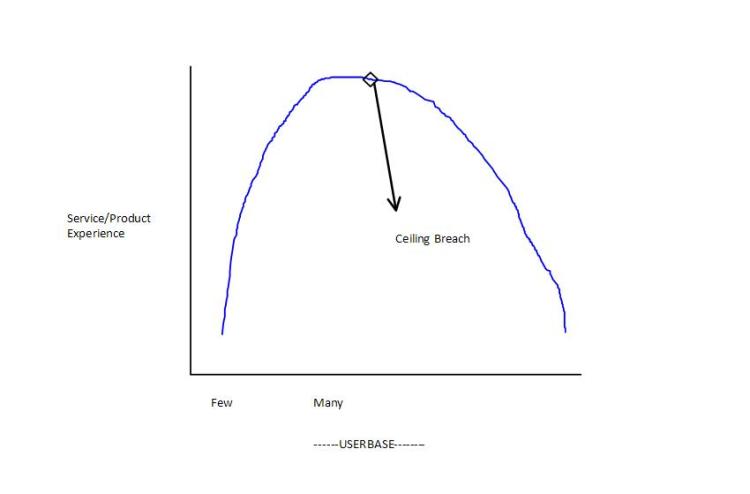
I suspect there is a threshhold in the lifecycle of a popular service/product when its supporting systems’ ability to deliver  a consistent user experience in line with the original mission statement is compromised and the product experience turns negative on account of this mass assault. Mapped out I think it will look like this :

As a owner/manager we need to work not just at ensuring we plan to prevent a scenario of a too little user base (call this a ‘flop’ or a ‘dud’) but also map what the infrastructure is  capable of handing the upper end and still delivering on the intended user experience. Because somethings sometimes become too successful for their own good.

Annual Appraisals are a waste of time

2010 is coming to an end and many enterprises here will commence the great eyewash and wasted exercise that is a annual employee appraisal. Like Hollywood movies in the 1970s that we Indians saw a few YEARS after they were seen in the western hemisphere, practices that are now being questioned over there are not raising the same level of skepticism over here.

Performance management isn’t an annual appraisal. But to judge you I will use my fragile memory and stumble and grope at how your complex contribution and performance over this year should be reduced to a single alphabet or number.

You know about the ‘Politics’ we all grumble and use as a crutch to explain why that brown-noser over there is moving ahead while we are crying at the ATM looking at the salary credited ? The cure to this if your boss is asmart person : Transparent Assessment Metrics. If your team complains about too much politicking then you/your firm have too little TAM. They are inversely related to the former.

Think about that as you warm up the laptop to start this outdated annual exercise.

without TAM


On Ambition and Busyness – Life Lessons from Video Games

This blog post is going to be about a video game, the career ladder, the Peter principle and Happiness research. And if you skip checking out the hyperlinks in this blog you are only eating the buns off this tasty burger.

I am a gamer. And although I am now exclusively committed to my xbox, my earlier gaming were on the PS2 and a Dell laptop. And it was on that Dell that I stumbled onto this game called ‘Caesar 3’ sometime in 2004. It’s under a genre of gaming called  CMS games (Construction and Management simulation). The most famous of this genre is SimCity which spawned the mega hit ‘The Sims’.

what Caesar 3 was all about : you have to start as a ‘village settlement leader’ in Roman times and help that village achieve a few key metrics (grow population to X, increase quality of housing, lower unemployment) and when you do, you get a designation-promotion and given a bigger and more challenging assignment. Some towns have a persistent barbarian invasion threat, some settlements are on arid land where crops wilt. The city is viewed in a two dimensional isometric view with a fixed magnification level, and can be rotated ninety degrees. When/If you beat all the assignments you become (drumrolls)……………….. ‘The Caesar!’

This game is tremendously absorbing and it is not too difficult to start and then become cripplingly addicted to it. I did and was. Watching a city grow under your care into a thriving happy place. And the more you play the more you get vested and sucked in.  This game taught me a ton about what I needed to know about the concept of ‘Career Ladder’.

At the earlier game levels the pace and tempo was mild and one got a chance to occasionally step back and just watch the city slowly grow and one could even leisurely zoom in and interact with the citizens and ask them ‘Sup?‘.

But at the advanced levels it was absolute a balls to the wall mad hatter party. Your city was big, the goals lofty and the operational tempo and daily fires numerous. If the barbarians weren’t beating at your gates, a fire in a section begged attention or a crippling famine was imminent. As the Mayor you were just shuttling from one crisis to another. I bet my mayor avatar inside the game was on his third divorce. Was it very absorbing ? You bet. Fun ? Hell yes. But I wondered if my Mayor ‘avatar’ and his family missed some of their earlier assignments. I would have if it was me!…esp since in some of previous assignments you got to really know your terrain, the town dynamics and area’s SWOT Rome lost a good mayor every time they transferred him (me) out to a different assignment.

The logic in the game mirrors logic in the corporate world : To reward excellence in a role –remove the person from the role! The greatest managers make a clear distinction between knowledge, skills, and talent, where talent is defined as natural recurring patterns of thought in a person. While knowledge and skills can be taught, talent cannot be. A key of management success then becomes finding the right kind of person for a given job. The best players are not automatically the best coaches. The skillset is different. Which now allows me to segue to The Peter Principle. = “In a hierarchy every employee tends to rise to their level of incompetence”

Dr.Lawrence J Peter was a observant genius. The principle he game his name to was first showcased in 1969….41 years later it seems MORE valid than ever. It is to the eternal shame of business schools that they don’t give this more coverage and study in the syllabus. Less classes on creating the next toxic subprime and more time on this stuff may be the way to go (I loved this recent gem : “Any sufficiently advanced financial instrument is indistinguishable from fraud.”). Don’t you, in some of the unnecessary meetings you are forced to join, slyly look around the conference room and wonder HOW half these idiots made it this far ? Voila! : The Peter Principle in action. Of course the others are looking at you and wondering the same thing.

Which leads me to Happiness and its research implications. Maybe at the certain place in time on your career ‘ladder’ you may wanna stay put or lower the speed to perambulate vs running. Princeton University’s Woodrow Wilson School concluded it’s a good idea to do it when you hit about $75,000 a year.

Here is a thought experiment : Let’s fill a small stadium with ALL the Fortune 500 CEOs and all their Admins. Who do you reckon is less stressed, healthier and happier with their life as a group ? Not richer. Happier. For me it’s not easy to answer this with ease or confidence and THAT raises more questions for me about what should I be chasing.

Definitive research on performance and stress dates back almost a century, to the work of psychologists Robert Yerkes and J.D. Dodson. In 1908, they came up with what is known as the Yerkes-Dodson Law, which goes like this: Performance increases as pressure increases, because stress-related hormones actually improve concentration. This occurs until a certain critical point — it’s different for every individual — at which the pressure exerts a negative impact and performance plummets. Graph it out, and you get something that looks like an upside-down U, with good stress on the left side of the curve and bad stress on the right. One thing that companies like Goldman, Ernst & Young, and Boston Consulting Group do is recruit people whose Yerkes-Dodson inflection points are much higher than average. “High achieving people generally like pressure,” says Kerr. But are ALL corporate employees like this ? Are you ? Maybe. But ALL trajectories for ALL good employees technically leads to the C-Suite. Is this standardized approach the way to go ? Ask yourself how high your Yerkes-Dodson inflection point is. Can you REALLY handle it ??  Or is society just egging you on because it, as a hive mind, knows no better ? Daniel Gilbert is onto something and you and I may be taking part in a race with a murky ending (the posh word is ‘affective forecasting’). Maybe sometimes ‘Small but happy town mayor’ would have been a good place to wrap a game.

On Education : the Con that is College Education

The Confederation of Indian Industry says that 25 percent of technical graduates and 15 percent of other graduates can be readily employed in the jobs that the recent boom has generated in the telecommunications, banking, retail, health care and information technology sectors. A report from NASSCOM says only 10 percent of fresh graduates are actually employable. A similar survey of MBA and engineering graduates reveals only 25 percent of them are employable. Education is the longest running con in India, second only in venality to the criminal institution that we optimistically call the ‘Government’.

When a broken antique system still is oversubscribed it takes smarts to question what looks on the surface as a winning system. It’s not. Here I need to make a key distinction. Primary education aiming to teach a kid the basic reading,writing and math skills is not in the same boat of con as higher education and university ‘education’. I mean how much ‘misguided’ stuff can you cram before the kid is ready for more than the 3Rs (Reading, wRiting, aRithmetic).

There is fierce debate globally (esp western democracies) over how to equip the next generation to be ready for the challenges. That debate over there is qualitatively different from what’s needed here. Over there the debate is getting the game to hit the HCF possible, able to compete with the Borg ship that is China and its neighbours. Here its trying to get the game to meet the lowest common denominator. Our far more basic and pressing challenge here is getting the graduating sheep to be minimally employable.

Anecdote time. In September I was looking to hire an analyst into my Service Management team and HR sent me a candidate they claimed looked good on paper. The usual 10+2+3+2 profile. The last 2 being an MBA student from a ‘college’ known for taking out full page ads laughably claiming to be better than the IIMs. Within about 3 minutes in my deputy and I realized we had a dud in our hands. I decided to go basic. I asked this ‘MBA’ student to explain what ‘topline’ and ‘bottomline’ was. He just started blankly at me. I could hear the crickets. Then he broke down. Right there. In front of us.

Bitter Nostalgia time. My 4 years at India’s premier hospitality management college was an all out rip off in that it did nothing to make me more employable into the world I was graduating into. All the value came from my own voracious reading at the library of generic books and magazines, my part time job at the local fast food outlet and this content aggregation and marketing company I set up to fund myself through the 4 utterly wasted years there. The lessons off classroom were invaluable and what I was taught in the classroom didn’t hold a candle to the former. As was the case for pretty much my entire batch. And we had whip smart people there (one guy got selected by ALL the IIMs) who sadly wasted four precious years learning how a commode designed in the 1930s worked. The wonder years indeed. The kind of place that Twain had in mind when he said “Some people get an education without going to college; the rest get it after they get out.”

Still it was a good place to make some life long friends and at least it was legit in the broadest sense. The biases of course helped us all cope. We joined blinded by optimism bias, survived with help from the ostrich effect and now a decade later  meet over drinks to celebrate rosy restrospection about a time at a place whose actual mission statement reads :

1.2 billion people. 500,000. graduating each year. 7500 are employable. A good con lasts a few minutes. A great con lasts a lifetime. Think of it like the difference between a mosquito that sucks your blood and is off versus a worm inside your stomach leeching off you for a very long time. I suspect 99% of the graduates succeed inspite and not because of their education. If this con is not in the Greatest Cons ‘Hall Of Shame’ someone has surely bribed the hall’s curator. Which would make sense in a kafkaesque way.

Why is the media not amplifying all this ? Same reason why the watchdogs don’t bark and bite. Follow the money. Conflict of interest. Why alienate the very group that’s taking out full page ads in your paper ? Why would the chicken coop guard shoot the fox when the fox is his paymaster ?

So what now ? Unless the consumer (the student and her folks) wise up to the con and choose very very carefully, this cash geyser will be in operation for a very long time. There are talks about a common exam all MBA students in India will take allowing hiring firms to see capability measured and endorsed by a neutral body. Shame on the government at taxing us and then not being able to weed out the corrupt institutions (forcing business to endorse something like the above)

You want to go radical ? Really really radical ? Gutsy ? Then I say skip this lame party entirely and home school yourself. All you need is a working internet connection and some books. And insatiable curiosity. And this website: http://personalmba.com/. That’s about it. You are in business. I’ll bet my last dollar a smart guy in a year on this can beat the pants off any average graduate vomited from the system.

Celebrity Endorsements is BS

Celebrity Endorsements are a fraudIt is a lie told to get the consumer to lower skepticism about the product/service.  Is the cola/chips/detergent/shampoo really better than all its competitors ? Is your hair really that lustrous because you really use that shampoo everyday or because you have the genes and a hair posse Ash ?

Have you seen Bachan Senior ? Is there any product category he won’t attach name to ? If you have the cheque I suspect he’ll endorse seal clubbing. Wait. He did. They did. Hrithik Roshan, Sachin Tendulkar and Shahrukh Khan….Remember the Home Trade ‘More’ campaign ? I love the way TimesOfIndia mocked the phenomenon. Genius.

Look I love Bachan. Is there any movie that captured both the angst and zeitgeist like Deewar did? But when you tell me to buy something I know you personally have never really been a fan of (cement!) you aren’t convincing me about the product but you sure are telling me something about YOU and your character with your faked sincerity and enthusiasm. That those two emotions can be purchased because its on sale. How crass.

Cricket and Bollywood have got so into this phenomenon I think its now reached a saturation threshold. I mean does the campaign really standout when the next 5 ads also have the same guy in it? Marketing experts will roll out reams of focus group and related studies showing how it works. How consumers want to identify with the celebrity and how their shampoo helps them get one step closer to that aspiration however misguided that instinct may be. Reminds me of the classic line from Tyler in Fight Club. ‘Sticking Feathers up your Butt does not make you a Chicken’ Just because you are blind and stumbling into a dark alleyway am I obligated to rob you ? Do ad agencies and companies go down this murky trail because proving genuine product superiority is murkier ? Or maybe impossible because its isnt superior? What about the downside ? 

At least stick to the profession. Ask a basketball pro to endorse basketball shoes. Don’t ask a mutimillionaire actor to endorse cement. Also please don’t get a model to wear a doctor’s coat and pout that I need to but this ‘scientifically proven’ soap/shampoo/paint/toothpaste/bazooka. That’s worse. I think you need to pitch to me with a smarter approach angle or maybe just use the budget in more innovative ways. Don’t tell me that’s impossible. BS. You go the endorsement path because its the laziest way to reach the target demographic. Not because its the smartest or most effective.

Most Office Meetings are a waste of time

This post is going to make sense only if you have seen this not-really-funny and what-is-the-message-here ad for these chips brand ‘Bingo Mad Angles‘.  The ad maybe does a poor job of its original intent (sell chips) but does a brilliant job of helping visualize something else.

Setup : The ad is in a conference room with some executives debating the perfect ‘angle’ of the chip being advertised. Perfect angle for what end ? Doesn’t say. It’s an utterly pointless meeting with an utterly unknown agenda. Where have YOU seen that before ? today ? Exactly!

I always wondered what breeds it ? This obsessive need to call for meetings to debate or discuss minutiae that, if examined carefully, is either

(a) part of the job description of someone at the table if only that culprit was more decisive OR (b) too minor to waste everyone’s time on.

Most of the time the meeting stems from a ‘Let me cover my ass, and diffuse this decision ownership so no one can pin it on me’ mentality. Rarely is it coming from a need to better decision quality. I too have been guilty of it on shamefully too many to count occasions.

Dr. Alex Lickerman, at Psychology Today warns that the decison quality of large companies suffers because of their size, which is often directly responsible for daily errors and omissions of communication. Further, the larger the company, the more responsibility for outcomes becomes diffused, often preventing any one person from feeling accountable for the quality of any one project.

And a meeting is one of the most expensive ‘things’ a company spends money on. The more senior the participants, the more it costs. This is obvious but behavior doesn’t allude to it. Reid Hastie is Robert S. Hamada Professor of Behavioral Science at the University of Chicago’s Booth School of Business helpfully suggests 3 things you can do to ensure you stray off into Oz in your meetings. Merlin Mann in a video talked about how his buddy used limited tokens at his company to ensure meeting-junkies didn’t have a free run. Watch this fantastiic TEDtalk by the Jason Fried. The actions starts at 8:44 mins into the video.

You as the customer are paying for this in the cost of the product. I bet (since software’s marginal cost of production is close to zero) companies like Microsoft pay a really heavy price for meetings. As pass it on. And most are just to discuss the Mad Angle of the Chips.


Airtel Name Change – Another Wasted Corporate Project

The new Airtel logo and rebranding is underway and the Airtel Marketing juggernaut is in full swing. No doubt they’ll get the job done. There are few thorny issues in this world that don’t go away if you throw enough money at it from a bottomless chest. 300 crore goes a long way anywhere. But to what end ?

I am an Airtel core-customer. That’s right. Core. 8 years. Blackberry services – Check. Mobile. Check. IPTV. Check. Internet. Check. All my media and screen based consumption has its imprint.

Overall I am happy with both their service and with their customer service. While I encounter the odd dolt who can’t speak English in an accent comprehensible anywhere in the solar system, I get my query sorted. eventually.

Now as a customer I don’t understand WHY my company has changed its logo which was well known and VERY well recognized to something which feel a tad cryptic and (gasp) looks like the Vodafone logo that lost a few pixels in a hurricane and got overturned.

Why change it ? Why not use that money (INR 300,000,0000!) to do something more pertinent. I would really like to see the Cost Benefit Analysis Case presented for this one. Some of their outlets are in need of desperate upkeep. The Noida Sector 61 one would be a good one to start off with. Or hire more reps to reduce hold time on their 121 helpline.

This exercise almost feels like the Airtel Marketing Department head and her team were bored and wanted something to do with their bountiful budget.

Beware the Billion Flies: Spotting Bullshit in Business Literature

TLDR: Beware of “data intimidation” in biz books where authors claim insights from “hundreds/thousands/millions” of interviews/studies; it’s often a sign of weak arguments. Upgrade your skepticism.


I remain a fan of business literature. The ‘will never go away’ problem as a reader is being able to filter the signal from the noise when choosing what to read. Separating the good books and authors from the pretenders is hard. Much of business literature is snake oil bullshit. 

But after years of exposure to snake oils I now have a decent ‘hack’/heuristic I can share.

If in the introduction chapter of a book the author uses an sentence resembling “….from talking to/interviewing/ analyzing hundreds/thousands/millions of….” immediately get into Bullshit Alert Mode.

I call the tactic “data intimidation“. Data Intimidation is a subtle tell that the author is not so confident of the conclusions and lessons in the book. The book’s author wants to ensure that when (it’s not an IF usually) you encounter grand flimsy claims, dubious conclusions or naïve “lessons” in the book you will suppress the tingling bullshit detector alarm beeping in your head and get cowed by the claims “….from talking to/interviewing/ analyzing hundreds/thousands/millions of….” . Any author can rightfully also claim “After interviewing BILLIONS of flies we conclude Shit tastes Good!”. Data Intimidation exploits the social proof phenomenon. 60% of the time it works everytime.

Readers : Immediately upgrade your skepticism levels when you read any writer try the data intimidation tactic.