
Where should you relocate to ?
Hopefully useful essays on navigating life and work

My one favourite place when in London is a Borders Bookstore. I have spent many pleasant hours is their flagship store on Oxford Street.

The third floor there has a Starbucks where you can, after you have vacuumed for your favourite books from the stores’ aisles below, ordered a latte, proceed to waste the day in one of the comfortable lounge chairs scattered throughout the store. I did sometimes end of purchasing a few books but I suspect most folks just read the books, bought the coffee and walked away when they were done with the former. Probably the only one thoroughly profiting was Starbucks.
Here are some facts I was able to collate from the net on Borders and its competition:
Borders : As of January 30, 2010, the company operated 511 Borders superstores in the United States….On February 16, 2011, the company announced that it had filed for Chapter 11 bankruptcy protection. In 2011 Borders finished 40 years in the business with 19500 odd employees. The last time Borders made a profit was 2006. Its yearly income has dropped by $1 billion in the four years since then.
Barnes & Noble : It is the largest book retailer in the United States, The company operates 717 stores and on Aug 3, 2010, BN announced that its board was considering a sale of the company, possibly to an investor group.
Amazon.com : Is a US-based multinational electronic commerce company. It was founded it in 1994. In 1999, Time magazine named Bezos ‘Person of the Year’, recognizing the company’s success in popularizing online shopping. It market cap now is $78 billion and revenue is at $34 billion.
Thing is I love Borders AND Amazon and would love to see both of them around for a long time. But in reality, out of every 100 bucks I spend on books, Amazon gets 99 and Borders gets 1. Because Amazon is cheaper and convenient. Maybe because they don’t pay rent on a bookstore in the middle of Oxford street.
In 1994 (when Amazon was founded) I am willing to bet the CEO, COO and CFO of Borders and Barnes & Noble, along with their core senior team must have been part of numerous expensive ‘annual strategy sessions’, golf retreats and team building exercises. There would have been people in that group from good B-Schools, familiar with Porter’s 5 forces model. And NO ONE in that group would have dreamed that in less a decade they would be done. Finished. And the double shocker would have been the added wound that it wasn’t because of the other guy (Borders vs B&N). Like Coke finding out they were beaten in the end not by Pepsi but by …Airbus (?!)

The top and bottom (amazon, e-books), did them in. If an overpaid consultant had told the book guys in one of that 1994 retreats that they all need to look at their business threat radar for ‘an online book store outselling them soon’ would it really registered in their mental model of the world they knew or would they have laughed the guy out of the room ? Mental Models are our fixed ideas of how the world works and how things should or shouldn’t be done. We accept these models so completely that we live our lives according to them. Everyone has mental models, but we call them by other names, like “truth” or “reality” or “the facts.” We believe them absolutely.
My contention : “We have an unsustainable business model“. That’s a sentence every C-suite occupant (the ceo,coo,cfo,cto..) should put on a laminated card and carry in his pocket.

Or is it ? Why ARE most solvent companies mired in mediocrity ?
Why do companies start in a burst of creative big bang and then slowly atrophy?
Microsoft. IBM. Xerox. Yahoo. GM.
Is it Risk aversion ? A concept in psychology, economics, and finance, based on the behavior of humans whilst exposed to uncertainty, Risk aversion is the reluctance of a person to accept a bargain with an uncertain payoff rather than another bargain with a more certain, but possibly lower, expected payoff.
We make choices about how we face risks every day. Some become very cautious, preferring to minimize risks even when the potential benefit of an action is tremendous.
It manifests when managers go for the tried and tested software, replacement hire or quailty management methodology.
But it is the Outliers that change the game and the play it safe mindset are excluding them all from ever getting a shot at the challenge.
I shop occasionally with Amazon and iTunes online but I am a Über-customer of Airtel, India’s communication behemoth. I have been with them over a decade and use pretty much every damn service they provide : Mobile Service. Broadband Service. BlackBerry Service. iPTV service. GPRS service. Landline service and two mobile numbers. They sell it and I’ll most likely buy it. Their service uptime is phenomenal.
Two days ago I made a purchase in error on Amazon. I bought a book I didn’t intend to for my Kindle. Realized it after an hour or so that I had done this. I emailed Amazon explaining how I goofed up and if they would kindly refund me. An amazon rep emailed in about 17 minutes telling me my refund has been processed and wishing me a good day. Something similar happened with iTunes a few weeks ago. Response time measured in the minutes in that case too.
About 3 weeks ago I tried to pay an Airtel bill through ‘MCHEK’, an Airtel bill payment system that debits your card. I always pay my Airtel bills through mChek. Very slick service and darn convenient. But this time I got an error message saying their payment platform was down. So I had to wait a day or so before it was up and running and unfortunately I was late paying my bill. They promptly added a ‘late payment fee’ when I paid the bill.
I emailed Airtel to reverse this fine they charged me as : 1# it was because of THEIR platform I was late 2# As a faithful decade long customer I deserved some better treatment and trust from them. (“Sir, you say it was down, good enough for us, here is the refund, have a good day!”)
Airtel has wonderful TECHNOLOGY but like most Indian firms, they think the race ends there, when the hardware is in place (or the building, or that gleaming foyer). But investment in customer service probably ranks in the P&L column ‘Pipe dreams of 2056 A.D’; A moron from their customer service called me, who displayed little IQ and understood even less. He said something along the lines of “PROVE TO ME SIR YOU ARE NOT LYING and we MAY consider reversing that charges. MAYBE!!”.
I think most customer service calls should just go straight to an IVR that truthfully intones “We’re sorry. The person you are trying to reach is unable to give a fu*k right now. Please find someone who cares and try again.” Like Marvin the robot would say in Hitchhikers Guide.
I like Airtel. I do. But they can so up their game and decimate the competition if they understood that trust is a two-way street. If you want the customer to trust YOU, then you damn well start trusting the customer. Treating folks who keep you in business like they are trying to bankrupt you out of it is a great way to ensure they defect to the firm that doesn’t.
Box 11 below nails it.

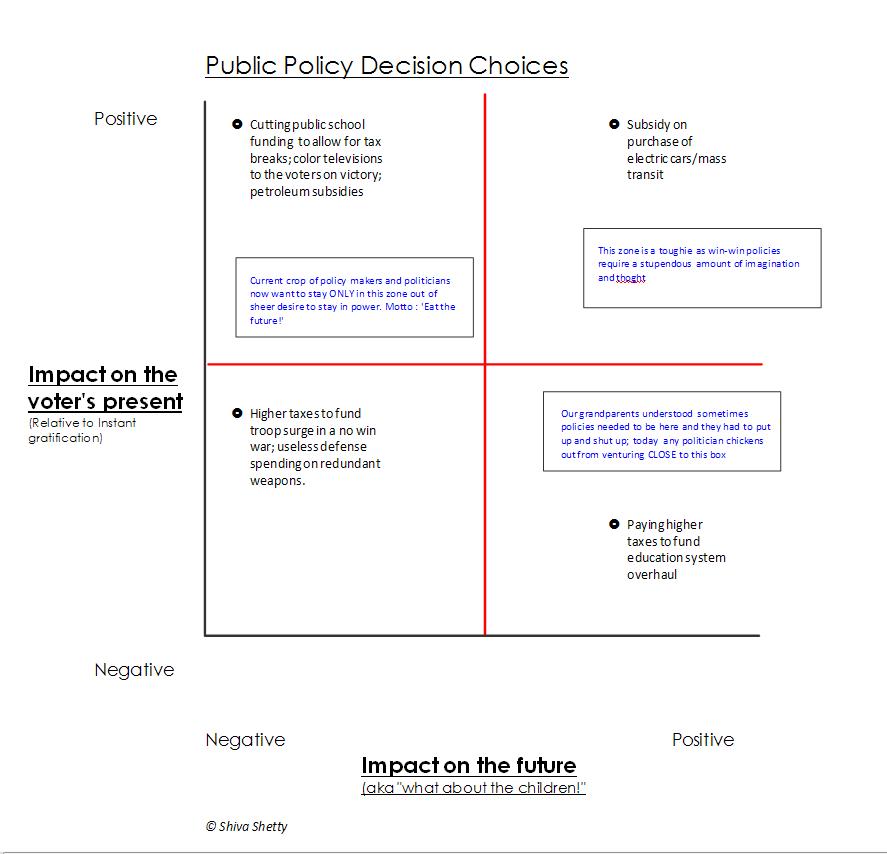
I just finished reading a piece by the always thought provoking Paul Krugman of the NYT. An Article entitled ‘Eat the Future’ , talking about how the GOP is sacrificing the future for the present over in US. It bought back to mind an article a while ago about free TV sets distribution by a corrupt party (are there any other?) that won elections in Tamil Nadu, India. Which I could parallel park next to an op-ed column ‘Serious in Singapore’ by Thomas Friendman published on January 29 about Singapore’s investment into the educational sphere.
Graphically these decisions by policy makers should all come into one of these four boxes :
Have you read the novel Dune ? You should. Wikipedia states “Dune is frequently cited as the world’s best-selling science fiction novel” In Dune you read about (no spoilers) a massive project undertaken by one party (Bene Gesserits) that demands investment by the new few generations so that generations much much into the future could enjoy a better future. Metaphorically, think of it like a tree that needs to be religiously tended by you and the next 16 generations, no payoffs, so Generation 17 onwards could enjoy its bountiful fruits.
Would you and I even think about planting this tree ? Could our current crop of politicians and policy makers be that altruistic ? Could a company or division expected to show good news in the next quarter ever contemplate a really really long term investment ? Why does mentoring, leadership training and executive development face minimal investment of time in most places ? In his absorbing memoir ‘Straight from the Gut’, ex-GE CEO Jack Welch talks about the flak he took when he made it clear he was going to invest in a manangerial Über School inside GE (GE’s Crotonville Campus). Circles of Causality are real and Jack knew it. We all should. Esp the CEOs, Politicians and Policy Makers who call the shots on long term investment. But maybe they all are only a reflection of the larger malaise of a whole generation bought up on the joys of instant gratification ? After all we get the politicians we deserve.
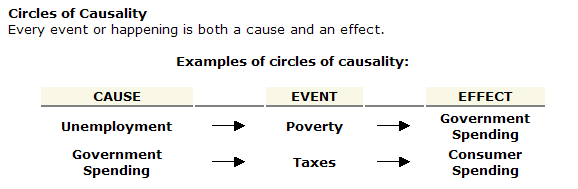
I was re-reading Senge’s masterpiece ‘The Fifth Discipline‘ recently and that book and the always fascinating concept of Systems Thinking it delves into allows you to examine these above policies in new light. Here is a quick summary of systems thinking :
Here is what I hope you to remember from this post as a Systems thinking caveat : Cause and Effect are not closely related in time and space. The ‘consequence boomerang’ comes back in a bit and not always to the same place it was thrown from.
Senge warns us that underlying all of the above problems is a fundamental characteristic of complex human systems: Cause” and Effect are not close in time and space. By “effects,” I mean the obvious symptoms that indicate that there are problems—drug abuse, unemployment, starving children, falling orders, and sagging profits. By “cause” I mean the interaction of the underlying system that is most responsible for generating the symptoms, and which, if recognised, could lead to changes producing lasting improvement. But most of us assume, most of the time, that cause and effect are close in time and space. As we are since a million years ago since walking upright.
When we play as children, problems are never far away from their solutions—as long, at least, as we confine our play to one group of toys. Years later, as managers, we tend to believe that the world works the same way. If there is a problem on the manufacturing line, we look for a cause in manufacturing. If salespeople can’t meet targets, we think we need new sales incentives. If there is inadequate roads, the solution must be more roads.
Moral : The next time you need to make a decision that is a trade off, remember some consequences may not be visible immediately. And they may be serious consequences . A cigarette feels great IN THE MOMENT.
Recently I wanted to buy a book a blog recommended. The book sold in India for 1300 rupees online. It was available in Amazon UK for 240 rupees, gbp converted to inr. I had friends in the UK who could get it to me quickly.
A good test of the fundamental strength of your business/ your company,does the following two questions scare you or give you hope :
What if the customer of what you are selling was really smart and well informed about his options ? Is that GOOD or BAD for your company ?
What if the customer of what you are selling was NOT constrained by Geography ? Is that GOOD or BAD for your company ?
If the answer to both were ‘We would be in good or better shape!’, then Congratulations. You are running or in the employment of a worthy business that should be looking at scaling UP.
But if these two questions drew a response along the lines of ‘We will die a painful death!’, re-look at the fundamentals propping up the business. And to you I say :
Since the number of digitally savvy people is trending UP, the first question above assumes a sense of urgency because your ‘moat’ in the first scenario is ‘our customer doesn’t have all the needed information so we have his business‘.
Since the number of international travelers is only trending north, the second question also assumes a sense of urgency because your ‘moat’ in the second scenario is ‘customer can’t get to the OTHER place’ and low cost airlines are very good at ensuring people get from A to B cheaply. You are currently located at A. That is a bad creaking moat.
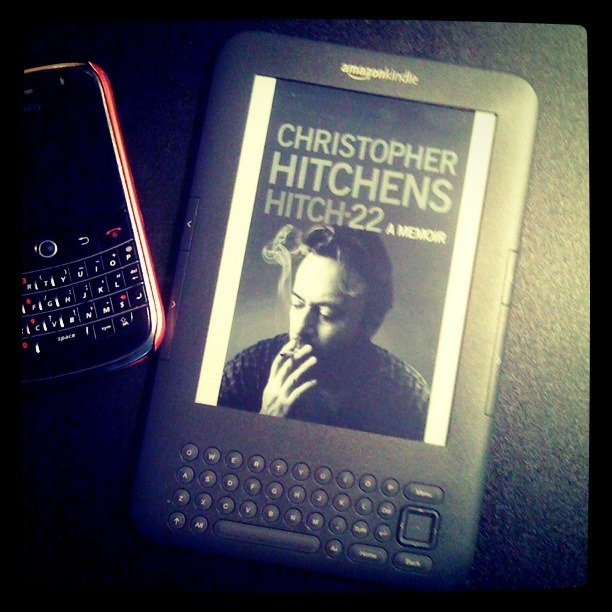
 Today you are ‘Just Another Customer’ of Christopher Eric Hitchens’ memoir.
Right off the bat I am going to come out and state that this is easily one of the smartest books I have read in the last few years. It is a rich nuanced book that will not disappoint. I suspect you will improve your IQ by about 10 points just from reading this book. Twice. You think (I can see your exaggerated eyes rolling from here) that I jest. I don’t.
Now here is Christopher Eric Hitchens. Before I finished with the book I had a vague idea of what a real ‘intellectual’ was in that sense of the word. I was in no doubt after I finished with Hitch-22. So this is the real stuff. And I will now strive to never mis-apply the title frivolously to someone who does not truly deserve it (and the contenders are many. Just switch to any news channel to see the underserving). Now be warned after you read Hitch-22 you are exposed to a mind so complex, smart and erudite, you will be a miser with the term for a long long time. In my limited frame of reference
I’ll hand it to maybe Dawkins, Dannett. Maybe Taleb and Naipaul.
This book is not a autobiography for sure and saying it is a memoir would, in the most accepted sense of the term, be wrong. Don’t jump into the pond expecting that. It feels (and not in a negative way)
like a lose collection of essays about places, events and people that, at the end, was chronologically stacked by the publisher right before going to the printing warehouse. If you feel disheartened to read it is so, you have very little idea what a treat you are in for anyway. Hitch himself confesses at the end
chapter that this book is a ‘highly selective narrative’. It is. But that is like saying Mozart is a ‘limited instrument artist’
Now do note :
I didn’t say Hitch-22 is absorbing in the ‘Kafka on the Shore’ sense, although in a way it so was and more. I didn’t say Hitch-22 is gripping in the ‘The Bourne Ultimatum’ sense, although in a way it so was and more. I didn’t say Hitch-22 is a page-turner in the strictest ‘The Girl with the Dragon Tattoo ‘ sense, although in a way it so was and more.
What is so refreshing is the level of real genuine soul bearing honesty Hitch brings to the table. His
chapter on his mum almost moves you to tears. Here is a man who is not coy or ashamed to admit he is guilty of some base vice, thought or flaw in himself. He makes little in the way of apology but the
very fact that he talks about it so candidly makes one realize how intellectually ethical man you are dealing with. You may not agree with him of everything (and boy does he hate a lot — Mother
Teresa, Bill Clinton, Henry Kissinger, Islam, God to name a few from a very long list). But I know this too : I would leave the safe keys with him anyway anyday. Here is a person who can be stone cold to his enemies in one paragraph and moved to tears by poetry in the next. There is so much in the book about the latter, I felt a rush of anger at myself and the early schooling years for killing any joy in it. One by making us take TESTS(!) on it. Curse you St.Joesph’s! One irritating miss in the book is how little he talks about his immediate kids and his two wives and one gets the impression that either they did little in terms of impacting his life or they were marginal players on the periphery in the real sense for decades. Which I suspect may actually BE true. The prose in the book is so mellifluous, so compact and so thoughtful I really thought i would, like the overused cliche, part with maybe some limb to be able to pen 2 pages of something like that once in my life. You know those pretentious wine tasting snobs who make such an elaborate show of taking a sip from the glass, swirling the wine and commenting on the ‘bouquet’ , ‘aroma’ et al. its a good metaphor though. Some lines and paragraphs in the book bring you to that level of absorption and involvement, where
you really enjoy each line and para and take your time taking it all in. This book can be discussed in the book club for probably a year, chapter by chapter. Here are a few of my favorite
from the book :
_____________________________________________________________________________________________________________________________________________________________________________________________
The usual duty of the “intellectual” is to argue for complexity and
to insist that phenomena in the world of ideas should not be
sloganized or reduced to easily repeated formulae. But there is
another responsibility, to say that some things are simple and
ought not to be obfuscated, and by 1982 Communism had long passed
the point where it needed anything more than the old equation of
history with the garbage can.
Plainly, this unwillingness to give
ground even on unimportant disagreements is the symptom of some
deep seated insecurity, as was my one-time fondness for making
teasing remarks (which I amended when I read Anthony Powell’s
matter-of-fact observation that teasing is an unfailing sign of
misery within)
Very often the test of one’s allegiance to a cause
or to a people is precisely the willingness to stay the course when
things are boring, to run the risk of repeating an old argument
just one more time, or of going one more round with a hostile or
(much worse) indifferent audience.
Totalitarianism is itself a cliché (as well as a tundra of pulverizing boredom)
One cannot invent memories for other people, and the father figure for my children must be indistinct at best until quite late in their lives. There are days when this gives me inexpressible pain, and I
know that such days of remorse also lie in my future. (I distinguish remorse from regret in that remorse is sorrow for what one did do whereas regret is misery for what one did not do. Both
seem to be involved in this case.)
I suspect that the hardest thing for the idealist to surrender is the teleological, or the sense that there is some feasible, lovelier future that can be brought nearer by exertions in the present, and for which “sacrifices” are justified.
It is not so much that there are ironies of history, it is that history itself is ironic. It is not that there are no certainties, it is that it is an absolute certainty that there are no certainties.
To have spent so long learning so relatively little, and then to be menaced in every aspect of my life by people who already know everything, and who have all the information they need … More depressing still, to see that in the face of this vicious assault so many of the best lack all conviction, hesitating to defend the society that makes their existence possible, while the worst are full to the brim and boiling over with murderous exaltation. To be an unbeliever is not to be merely “open-minded.”
It is, rather, a decisive admission of uncertainty that is dialectically connected to the repudiation of the totalitarian principle, in the mind as well as in politics.
_____________________________________________________________________________________________________________________________________________________________________________________________
I felt bad after reading this book and you will too. Of the 6.5 billion folks on the overcrowded planet, you realize maybe a stadium full of people have lived a life as interesting, exciting
and so damn alive as Hitch. I am sorry to say a lot of the politics he lived and pens about went right over my head. (…But as proof of prose, it made me go on amazon and purchase Tony Judt’s
“Postwar: A History of Europe Since 1945” JUST SO I COULD understand his book better.yup. That good) And reading the book was like surfing the net in that I was constantly wikipedia’ing so much
: Spanish war, Cuban revolution, Trotskyism, myriad poetry verses, about 50+ writers and so on. If books are meant to expand the mind I have not come across too many that match the sheer horsepower of Hitch-22. Carpe diem. Buy the book. ps : If you are curious about Hitch, here are 2 starter videos to know the man better :
2010 has drawn to a close, the lists and best/worst awards are all being punctually distributed. I am going to add mine to the mix. 2010 was an awesome year and here is to 2011 making it look ‘meh’. Happy New Year.
Here goes the totally gut based unscientifically selected winners …and added bonus for me: Of all the posts I penned so far on my blog, this one I really really enjoyed writing. Didn’t feel like a chore at all.
#Best New Brand I came in touch with in 2010 : Air Asia
Low Low prices. Smokin hottt crew. Sanitary bathrooms. Clean new planes. So I am totally rah-rah’ing behind them for being able to demonstrate how you can be Cheap without being ‘Cheap’. Something demonstrated by Air India and American Airlines to be astoundingly easy.
Take Away : Being able to convincingly demonstrate an inverse link between the product experience and its pricing is an art and Air Asia is looking like Van Gogh.

#Best Value For Money : Street food in Bangkok
Back here, low-priced food means you are also involuntarily participating in heath roulette. You may or may not get sick you brave gambler you. Not so in Bangkok. Low prices only meant you just didn’t get the silverware with the food. All else was totally top notch.
Take Away : being able to demonstrate how you can be low-priced without being unhealthy/poisonous.

#Best FREE service: The Staten Island Ferry
There is no better way to glimpse Lady Liberty, enjoy the view of Manhattan from a distance AND avoid the hassles of a touristy trap up close than this surprisingly free ride to Staten Island and back on the ferry. The ferry is clean, well maintained and run by a decent crew.
Take Away : being able to demonstrate how you can be govt owned and run without being dirty or inefficient.

# Best Customer Service Experience : Virgin Atlantic, @London Heathrow. Missing a Virgin Atlantic London Delhi flight by 9 minutes and getting a NO CHARGE NO HASSLE next day ticket in the next 9 minutes. Stupid me did not catch the name of the customer service rep girl. But she made her airline look bloody darn good. Take Away : Being able to demonstrate all airline reps are not hostile surly harridans.

#Best FREE city experience : Courtesy the municipality of Paris. Free deck chairs at the Jardin des Tuileries near the Louvre in the summer, allowing anyone to park their tired selves and just enjoy straight line views of the Arc De Triomphe and the Eiffel.Take Away : Sometimes all the citizens want is a good view and a place to see it from.

#Most Unexpected Good Meal : A very unassuming bakery in Rome that served the most orgasmic lasagna I have yet tasted. And a price that did not do justice to what the dish managed to do to your tongue and mood. For those interested, this one is right at the entrance of the Battistini Metro Station. A bowl of mussels at a restaurant near the Nation metro St in Paris comes a close second and beaten because the price was too damn low for the lasagna.
#Most anticipated Good Meal that delivered: Cu Cha (sea food like you will never taste again or have before) and W.A.W (world’s best chicken wings) on Jalan Alor St. I could just park permanently at these two places, drink the local beer and watch the Kuala Lumpur crowd all day till the inevitable heart attack from obesity gets me.
#Worst Rip off at a tourist trap : The visually inviting street side restaurants near the common tourist spots in Rome. Justyna and I were parted with what was a frightening amount of our euros for what was a very bland and forgetful meal near the Pantheon.
Take Away : Location.Location.Location. We get it. But don’t just stop there. Work on the damn product!
#Best FREE quality Performances : Edinburgh Festival, August 2010. The theater was the street and by God, what theater!

#Best FREE sublime experience : Crowd watching parked on the fountain footsteps near the Pantheon, Rome. The people, the passing performers and sheer variety of tiny interesting people related episodes unfolding before you is a treat, made sweeter by the fact it’s totally absolutely free.
#Product I(we?) have the most ‘love hate’ relationship with.

#Most Welcoming Experience : Being allowed INSIDE Harvard Business School’s famed Baker Library AND its underground book depository collection without being a student or bring escorted by one. The whole campus had a vibe around ‘visitors’ that was so amazingly friendly for a place of its size and importance. Local 2 bit malls’ here are 100 times more paranoid, brooding and hostile to the casual visitor.
Take Away : For proving importance CAN have a inverse relationship with security theater vs a direct one.

#Most reliably consistent product : The BlackBerry Bold 9000. Dropped it in snow, concrete, puddles, from a height plus a myriad other abuses and it just keep on getting and diligently sending them emails. BlackBerry…oh how I love thee.
Take Away : sometime being a hedgehog that does one thing very well and consistently is all a user wants,needs and requires of a product. When commercially profitable, pander to the instinct if you can.
#Most irritating company to deal with as a customer either by telephone or on their website : Lloyds Bank!
#Most overpriced service/product not worth repeating : the GMAT exam as ‘sold’ by gmac.
#City that quite doesn’t deliver : Singapore. It’s a fantastic city but feels a tad too sterile and unimaginative. But I am still going to say I am a fan. Sue me for the contradictions.
#Most stunning good discovery : At the ‘will be crowded soon’ I.G.I-T3 Food Court : My travel buddy and I came across this food joint. Best fries ever. Name ? Like that best burger episode from HIMYM, I do NOT remember. ‘Four’ something . If you know which place i refer to, gimme a shout.
#Best website you probably don’t know about on the net : www.couchsurfing.com~ the experience it encourages will solve so such of all that is wrong out there in the world and as a bonus, will give its users one hell of an eye-opening experience in the process. Huge fan. Second Spot : www.AirBnB.com. Just plain works as advertised on the tin. I paid 900 rupees (=$18) a day for a 3 bedroom flat all to myself in Budapest.
#Experience I regret rushing through : The Met in NYC and the Louvre in Paris. I made the cardinal sin of seeing them in a hurry. Shame on me.
#Best author discovered this year : Ouch. This one is close. So I will (because I can!) award it to two geniuses I stumbled onto this year : V.S.Naipaul. Christopher Hitches.

And now the GRAND Prizes….
###Product of the Year : Amazon Kindle.Where do I even begin. Yes, I am a bibliophile and so it may feel nerdy to vote for this but here is the kicker: This year I ALSO came into an iPhone 3G and the latter doesn’t hold a candle. And that IS saying something, considering the rabid fans and press apple enjoys. From the physical product to the reading experience to the ease of purchase and download of books, this 200 gms baby is a true game changer. It has actually fuelled one of my resolutions to have NO physical books in 5 years. Move everything to this tiny marvel, an ode to all this is right about technology.
###Location of the Year : Soi Rambutri St, Bangkok.
There is, on this venerable street, a restaurant that spills over onto the street with a sheesha seller near by (order the double apple flavor) This place is by policy and open boast: NEVER closed. From early every evening till very very late at night (4 am), if you are looking for the experience to cherish : just get your mates, order the double apple sheesa from Rahul, a few bottles of chilled Singha beers and just sit back for the world’s best ‘lounge music + street fashion show’ combo experience. And end it with a non-sleazy massage at the myriad options nearby. Welcome to the good life. no riders. no big bill at the end.
###Experience of the Year : Paris.
To watch the Eiffel light up at midnight, with your gf, on your birthday, on a anchored boat on the Seine that you surreptitiously sneaked into at midnight, with beers and pizza, under a cool evening. Hard to top. But then…..would you really want to ?
(2011 Update : The winners of the 2011 ‘awards’ are here)


 Third Eye Observations