
Narrative is looking at an event and then making up a good story around it. Usually the narrator highlights bits in the story that supporting his point of view. But if done badly it misses a lot of important details.
Most op-ed columns today are entertaining narratives masquerading as Insight. Most LinkedIn articles are badly worded Narratives. As is the daily “news” on TV.
The writings of Charlie Munger, Warren Buffet and Peter Drucker mostly provide genuine Insight. Most modern writers are more like Tom Peters and Jim Collins. They sell slick narratives.
Germ Theory Is Insight, Homeopathy is narrative (fraud) peddling as guaranteed cure. Darwin’s Evolutionary Theory is Insight, Creationism is narrative bullshit. Most history books are faulty narratives. Calvin is onto the lie.
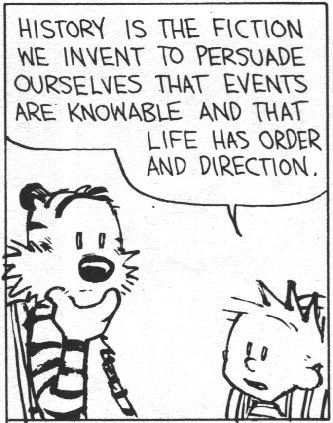

Embarrassingly it took me far too long to arrive at this basic understanding : Most of what we read in books, newspapers and watch on TV is ‘Narrative‘ and not ‘Insight’. And they are sold as the Insights while not being real insights at all. Fraudulent is a good word to use here. Narratives are shallow opinions and flawed arguments that follow basic storytelling rules. Humans are naturally drawn to these stories because of how our brains are wired, ever since we started walking upright. Some narratives are so good even the author of the narrative is fooled into thinking she is dispensing Insight. Insight is profound, hard earned and life changing. Most informational buskers peddling narratives (think most columnists) are very convinced they are selling profound never-before-imagined Insight. It takes some experience to see the difference (hell, it took me 3 decades to even know there was a difference).

We live in a world where there’s a lot of unimportant or distracting information (noise) and very little meaningful or useful information (signal). Fake News but not in the way DJT made the word famous. More subtle. Narratives are like a heavy, wet blanket that clumsy writers throw over unrelated events (like the many boring history books we all read in school) to make them seem like they fit together into one easy story. They’re like forcing things to fit just because (like the story of how the stock market dropped today because of reasons Y and Z). These stories feel good to us humans because they’re comforting, but it’s real understanding (insight) that truly benefits us. Like junk food but for the brain.

I made a resolution to read lots of longform articles a few years ago. I made some rules for myself. They needed to be across multiple publications, on multiple topics and posses different points of view. Why these rules ? Because I realized that a lot of what I had been consuming was mostly Crappy Narrative disguised as Amazing Insight.
Some stories are really good and help us understand our world better. For example, “The Godfather” movies give us great lessons about business, family, how to make decisions, and relationships. But unfortunately, there’s a huge flood of fake deep thoughts and poor stories out there that overshadow the small stream of true insights we can find.
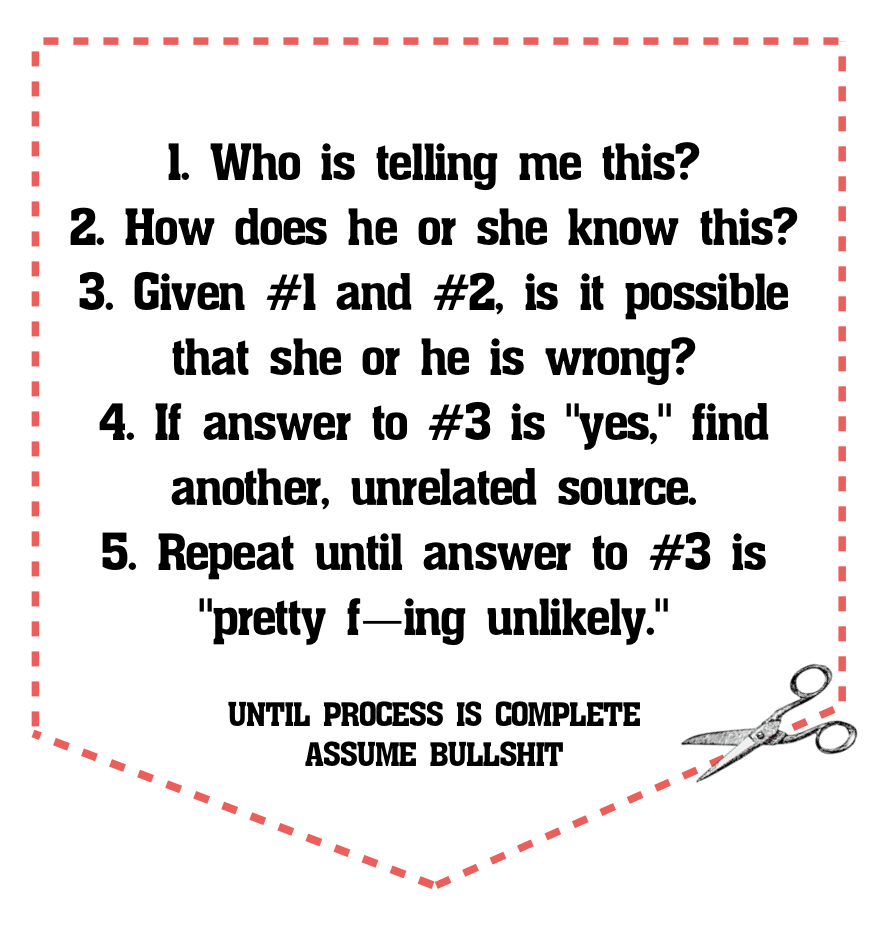
The maxim “Good Judgement comes from Experience; Experience comes from Bad Judgement” applies here. The ability to smell the distinction can be honed only by marinating long and hard in both forms early, to make sure later you are inoculated against crappy narratives and can sense them instinctively. When reading suspect material make it a reflex to ask these 5 questions of the info-peddler :
Time spend reading and thinking to get some insight is vastly more useful in life than time spent reading some simplistic narratives just because it is comforting and demands little of you.
Choose Hard Insight. Ignore Easy Narratives.
The End.
 Third Eye Observations